
Varanasi 2-Day Itinerary: Temples, Ghats & Food
Follow this Varanasi 2-day itinerary through temples, ghats and food lanes, with practical routes around Godowlia, Assi Ghat, Lanka and BHU for a weekend.
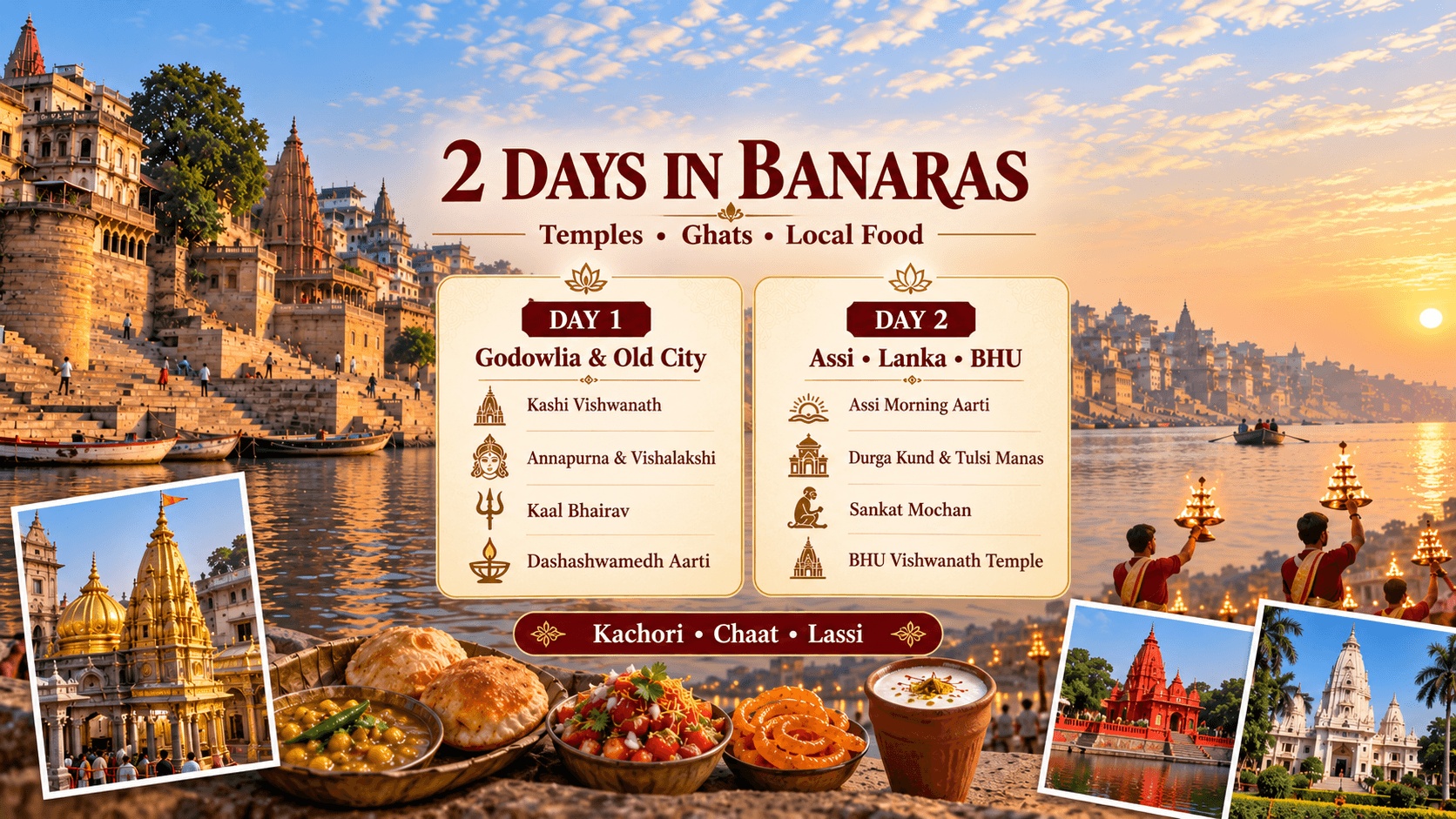
Two days in Banaras are enough for a rewarding introduction to its temples, riverfront and food, provided you plan around neighbourhoods rather than travelling repeatedly across the city. This Varanasi 2-day itinerary brings together Kashi Vishwanath, Kaal Bhairav, Dashashwamedh Ghat, Assi Ghat, the temples around Durgakund and Banaras Hindu University.
Spend the first day around Godowlia and the old city, with a separate excursion to Kaal Bhairav. Keep the second day for Assi, Durgakund, Lanka and BHU. Along the way, make room for kachori-sabzi, jalebi, tamatar chaat, lassi and an unhurried meal.
The itinerary assumes two full days in Varanasi. Ideally, arrive on Friday evening and leave late on Sunday or on Monday morning. If your arrival, departure or temple queues shorten the day, follow the main stops and choose just one optional addition.
Where to stay: Godowlia, Assi Ghat or Lanka?
All three areas suit this itinerary, but they offer different advantages. Assi and Lanka are connected neighbourhoods, not interchangeable locations: a hotel near the BHU entrance is not necessarily a short walk from the river.
Stay area | Why choose it? | What to check before booking |
|---|---|---|
Godowlia and nearby old-city lanes | Convenient for the Day 1 temple circuit, markets and Dashashwamedh Ghat | Exact walking route, luggage assistance, stairs, noise and the nearest permitted vehicle drop-off |
Assi Ghat and adjoining streets | Useful for the dawn programme, riverfront walks and returning to the ghat in the evening | Actual distance to the ghat, road access, lift availability and whether a river-view room really faces the river |
Lanka and the BHU entrance area | Useful for BHU, the southern temple circuit and meals around Lanka | Distance to Assi, local transport and the property's precise map location |
Godowlia is a practical base if Kashi Vishwanath is your main priority. Assi makes the early start on Day 2 easier. Lanka suits visitors who prefer to base themselves near BHU and travel to the riverfront.
The Kashi Vishwanath Temple Trust currently describes the Godowlia–Maidagin stretch as a no-vehicle zone. Confirm the latest access arrangements with your accommodation, especially when travelling with heavy luggage or someone who has difficulty walking.
The two-day route at a glance
These are suggested planning windows, not official opening hours or guaranteed journey times. Allow extra time for security checks, traffic, festivals and darshan queues.
Day | Part of the day | Suggested plan |
|---|---|---|
Day 1 | Early morning | Kashi Vishwanath and Annapurna Temple |
Day 1 | Morning | Breakfast, Vishalakshi Temple and a short old-city walk |
Day 1 | Late morning or early afternoon | Kaal Bhairav, subject to that day's darshan schedule |
Day 1 | Afternoon | Lunch and rest; optional Nepali Temple or shopping |
Day 1 | Evening | Dashashwamedh Ghat, Ganga Aarti and chaat |
Day 2 | Before dawn and morning | Assi Ghat, Subah-e-Banaras, breakfast and an optional short heritage walk |
Day 2 | Late morning | Durga Kund, Tulsi Manas and Sankat Mochan |
Day 2 | Afternoon | Lunch around Lanka, BHU and New Vishwanath Temple |
Day 2 | Evening | Assi Ghat, evening aarti if staying late, and dinner |
Day 1: Godowlia, Kashi Vishwanath and the old city
Start early at Kashi Vishwanath Temple
Begin with Shri Kashi Vishwanath Temple, dedicated to Shiva and recognised as one of the twelve Jyotirlingas. It is the central temple visit in this itinerary. Arriving early leaves more room for the surrounding lanes and shrines, although an early start does not guarantee a short queue.
Allow a generous buffer instead of scheduling another activity immediately after darshan. The approach, security screening, queue and time spent within the complex can vary substantially.
Travel light. The Temple Trust's current instructions prohibit electronic devices inside the temple premises, including phones, cameras, smart watches and electronic keys. Locker facilities are limited, so leave unnecessary belongings at your accommodation where practical. Confirm entry arrangements and any booking requirements through the official temple website.
General darshan and Mangala Aarti are different arrangements. The Trust requires a valid ticket for Mangala Aarti; an early-morning visit should not be assumed to include it. This itinerary does not depend on a Mangala Aarti booking.
Add Annapurna Temple
Visit Annapurna Temple in the Kashi Vishwanath vicinity, subject to its opening and darshan schedule. Dedicated to Goddess Annapurna, traditionally associated with nourishment, it fits naturally into the same morning circuit.
There is no need to rush between the two temples. Leave time to find the appropriate entrance, remove footwear and follow local instructions. Small distances in the old city can take longer than expected because of queues and narrow passages.
Pause for kachori-sabzi and jalebi
After your first temple visits, stop for a Banarasi breakfast. Kachori-sabzi and jalebi make a useful introduction to the city's food, particularly when you have started before dawn.
For a named old-city option, The Ram Bhandar in Thatheri Bazar is listed in a recent District food guide for kachori-sabzi and jalebi. Check the current map pin and opening status before setting out; breakfast availability may depend on the morning batch. Avoid making breakfast a long detour if darshan has already taken several hours.
Visit Vishalakshi Temple and explore the lanes
Continue to Vishalakshi Temple, in the old-city lanes near Meer Ghat. Dedicated to Goddess Vishalakshi, it adds another important Devi shrine to the day's temple circuit. Follow current visitor and photography instructions.
Use the rest of the morning for a short walk through Vishwanath Gali, Chowk or Thatheri Bazar, choosing a route that fits where you emerge from the temples. Look at the shops, small shrines and everyday activity rather than trying to cover every lane.
If buying a Banarasi saree or fabric, ask about the material, weaving method and price, and take a bill. Allow proper browsing time instead of treating shopping as a five-minute stop between temples.
Make a separate visit to Kaal Bhairav Mandir
Kaal Bhairav Mandir deserves its own place in the itinerary. Kaal Bhairav is revered in local religious tradition as the Kotwal of Kashi, the city's guardian. The temple provides another perspective on Banaras's sacred geography.
Although it belongs to the broader old-city circuit, it is not beside Godowlia or Dashashwamedh Ghat. Depending on your starting point and current access restrictions, use a combination of walking and local transport, with the final approach on foot.
Check the day's darshan schedule before travelling. If it clashes with an afternoon closure or the queue at Kashi Vishwanath runs long, move this stop to an available visiting window rather than abandoning lunch and rest.
Some devotees prefer to visit Kaal Bhairav before Kashi Vishwanath. You can reverse the order of these main temple visits to suit your own practice; the sequence here is a suggested travel plan.
Keep lunch and a rest break
Take a proper lunch break after the temple circuit. A vegetarian thali or another freshly prepared meal can be more practical than continuing entirely on snacks. Return to your accommodation if the weather is hot or your morning has involved prolonged standing.
Keep at least one flexible block in the afternoon. This is what makes the route manageable when temple visits take longer than expected.
Optional heritage stop: Nepali Temple and Lalita Ghat
If you have time and energy, visit the Nepali Temple, also known as Kathwala Temple, at Lalita Ghat. Its distinctive Nepali design and carved woodwork offer an architectural contrast to the other temples on the route.
Use this as a short temple-and-riverfront addition, subject to current access and opening arrangements. Wear shoes suitable for uneven lanes and ghat steps, and follow photography rules inside the temple.
Choose this stop or an extended shopping session. Including both, along with every temple, can make the first day unnecessarily hurried.
Evening at Dashashwamedh Ghat
Return towards Godowlia and walk to Dashashwamedh Ghat for the evening Ganga Aarti. The coordinated ritual with lamps, incense and chanting is a central part of a first visit to Banaras.
Confirm the start time locally that day; seasonal schedules and special occasions can affect arrangements. As a planning buffer, aim to arrive around 45–60 minutes before the confirmed start, earlier during particularly busy periods. This is an arrival suggestion, not an official requirement.
You can watch from the public ghat area. Rooftop seating, organised viewing arrangements and boat services may have separate charges. Ask about the complete price before agreeing to any paid option.
Keep passageways clear and leave time for the crowd to disperse afterwards. If travelling with children or older family members, agree on a meeting point before entering the busiest area.
Food to try around Godowlia and the old city
Spread your tasting stops across the day rather than trying everything after aarti.
Food | When to fit it in | Practical suggestion |
|---|---|---|
Kachori-sabzi and jalebi | Breakfast | Choose a morning stop near your temple route |
Tamatar chaat | Late afternoon or evening | Try a small portion before ordering more |
Aloo tikki or another chaat | Evening | Share portions if sampling several dishes |
Lassi | During a daytime break | It can be filling; plan it apart from a large meal |
Rabri or another milk sweet | Dessert | Check availability at the shop you choose |
Banarasi paan | An optional finish | Specify your preferred filling, including tobacco-free if desired |
Kashi Chaat Bhandar is a named chaat option to look up around the Godowlia circuit. Deena Chaat Bhandar in the Luxa area requires a separate detour and is listed for tamatar and palak patta chaat. Blue Lassi, in the lanes near Manikarnika, fits an old-city daytime walk better than a rushed post-aarti food run. Check each shop's current location and trading hours.
Manikarnika is an active cremation ghat. If your walking route approaches it, give funeral processions space and do not photograph cremations or grieving families.
Day 2: Assi Ghat, Durgakund, Lanka and BHU
Reach Assi Ghat before dawn
Start the second day at Assi Ghat for Subah-e-Banaras. The organised morning programme includes aarti and cultural elements such as music, with the exact sequence subject to the day's arrangements. It gives the weekend a different riverfront experience from Dashashwamedh's evening ceremony.
Confirm the next morning's reporting time the previous evening. Arrive before the programme begins rather than relying only on sunrise time: the aarti can start before the sun is visible.
Stay for the parts that interest you, then spend a little time by the river. If staying in Godowlia or Lanka, arrange the early transfer in advance instead of depending on finding transport at the last moment.
Breakfast near Assi and an optional walk
After the programme, have breakfast near Assi. Choose poori-sabzi, kachori-sabzi, or a lighter café breakfast according to your appetite. Tea makes a simple pause before the next set of visits.
If you want more walking, take a short riverside stroll towards Tulsi Ghat, associated with the devotional and literary traditions surrounding Tulsidas. Keep it short enough to leave time for the temples.
Lolark Kund is another optional heritage stop in the broader Assi–Bhadaini area. This sacred stepped tank is associated with the solar deity Lolark Aditya. View it respectfully from permitted areas and avoid descending into restricted or slippery sections.
Choose Tulsi Ghat or Lolark Kund as an addition; neither is essential to completing the main itinerary. River conditions may also make portions of a ghat walk unsuitable.
Visit Durga Kund Temple
Continue inland towards Durga Kund Temple, dedicated to Goddess Durga. Its red appearance, North Indian temple architecture and adjoining kund distinguish it from the morning's riverfront stops. [11]
This is part of the Durgakund temple cluster, between the broader Assi and Lanka areas. Allow time for darshan and follow the instructions at the entrance. Crowds can increase during religious occasions, particularly those associated with the goddess.
Walk or take a short transfer to Tulsi Manas Mandir
Tulsi Manas Mandir lies near Durga Kund and is dedicated to Lord Rama. The temple commemorates Tulsidas and the devotional legacy of the Ramcharitmanas. Its marble surfaces carry inscriptions from the text.
It adds a literary dimension to the temple trail: take time to look at the inscriptions and surroundings rather than treating it simply as another darshan queue.
The present temple is a modern structure. It should not be described as an unchanged surviving building from Tulsidas's lifetime.
Continue to Sankat Mochan Mandir
Next, visit Sankat Mochan Mandir, dedicated to Hanuman. It is one of the principal temple stops on this southern circuit and is geographically suited to a day centred on Durgakund and Lanka.
Check current opening and security arrangements, especially before planning a midday visit. Follow the temple's rules for belongings, footwear and photography, and leave space for regular worshippers.
The three temples make a substantial late-morning programme. If crowds are heavy, reduce the optional heritage walk rather than rushing through the main visits.
Lunch and local food around Lanka
Head towards Lanka for lunch and a break. Look for a vegetarian thali, a simple rice-and-dal meal, or baati-chokha where available. A sit-down meal is useful after a dawn start and several temple visits.
For smaller food stops, consider lassi, chaat, jalebi or seasonal sweets according to availability. These are dish suggestions, not promises that every stall serves them throughout the day.
If you are seeking a particular well-known Lanka food shop, check its current map pin rather than relying on older travel posts. Food businesses can move, and a familiar name does not guarantee that the old address remains correct.
Malaiyo and choora matar are associated especially with the cooler season. Treat them as seasonal possibilities rather than items guaranteed on every weekend menu.
Explore BHU and New Vishwanath Temple
Enter Banaras Hindu University through the Lanka side, subject to current campus access rules. BHU adds a different setting to the trip: university roads and institutional spaces contrast with the tightly packed old-city lanes.
The main visitor stop is New Vishwanath Temple, also called Vishwanath Temple, BHU, and commonly known as Birla Temple. Dedicated to Shiva, it is a separate temple from Kashi Vishwanath in the old city. Make this distinction when arranging transport or following a map.
The temple is inside a large campus; reaching the Lanka gate does not mean you have reached the temple. Allow for onward travel within permitted areas and confirm what transport is available.
Combine the visit with a short campus walk, while respecting academic and residential spaces. Avoid attempting to cover the whole university after an already full morning.
Bharat Kala Bhavan: an optional Saturday swap
For visitors interested in art and material heritage, Bharat Kala Bhavan is a worthwhile museum option within BHU. Its collections include paintings, sculpture, textiles and manuscripts.
However, BHU's current listing states that the museum is closed on Sundays and national holidays. It lists regular visiting hours as 10:30 AM–4:30 PM, Monday to Saturday, with different summer hours during May and June. Reconfirm before visiting.
On a Saturday–Sunday trip, do not rely on visiting it during the standard Sunday BHU stop. If it is a priority, swap the two neighbourhood days, visit BHU on Saturday and plan the museum within its confirmed hours. Omit some optional stops to make space.
Return to Assi for the evening
If your departure permits, finish near Assi Ghat. You can attend the evening Ganga Aarti after confirming that day's schedule, take a short walk or have dinner at a nearby café or restaurant. Assi has an evening aarti as well as the morning programme.
If catching a train or flight, skip this return rather than cutting your transfer margin. Two early starts and a full temple circuit are already a complete weekend.
Optional additions: choose one, or save them for another visit
The main route already includes eight temples. More stops are useful only when they match your interests and available time.
Place | Why consider it? | How to fit it in |
|---|---|---|
Sankatha Devi Temple | Another Devi shrine in the old city, near the Scindia Ghat area | Replace the longer shopping or Nepali Temple visit on Day 1; expect additional walking [3] |
Gauri Kedareshwar Temple and Kedar Ghat | A Shiva temple and riverfront stop south of Dashashwamedh | Choose a dedicated extra walking segment; do not treat it as next door to either main base [18] |
Sarnath | Buddhist heritage, stupas and monastic sites | Replace a substantial part of one day or add a third day; it lies outside this two-neighbourhood circuit [19] |
Avoid adding Sarnath, Ramnagar and another distant temple circuit to the same afternoon. A two-day visit is more useful when you can spend time at the places you choose.
Getting around and visiting comfortably
Walk the old-city lanes and use transport between clusters. Autos, e-rickshaws or taxis may help on accessible roads, but permitted drop-offs can change. Agree the fare and drop-off point before starting. Save accommodation details and your planned route before leaving electronic belongings behind for darshan.
Keep temple hours separate from your suggested schedule. Smaller temples may pause darshan, and special occasions can change arrangements. Recheck the next day's visits locally rather than assuming that every temple is continuously open.
Allow for steps and uneven ground. Old lanes, queues and ghats can be demanding for anyone with limited mobility. Ask accommodation staff and temple help desks about accessible approaches, and shorten the route where necessary.
Dress and photograph respectfully. Wear clothing suitable for sacred spaces, remove footwear where instructed and ask before photographing people or rituals. Follow restrictions within temples, even when photos are permitted outside.
Make any boat ride optional. A short river trip can replace another activity when services are officially permitted and conditions are suitable. Confirm the route, complete fare and life jackets before boarding. High water, weather or administrative restrictions can interrupt services; this itinerary works without boating.
Frequently asked questions
Is two days enough for Varanasi?
Two full days work for this focused temple, ghat and food circuit. They do not provide enough time for every major attraction plus Sarnath and nearby excursions at a relaxed pace.
Are all Day 1 places near Godowlia?
Godowlia is a useful starting point for Kashi Vishwanath, nearby shrines and Dashashwamedh Ghat. Kaal Bhairav is a separate excursion within the broader old city, and some food and heritage stops require additional walking.
Are Assi Ghat and BHU next to each other?
They belong to the broader southern visitor circuit, but they are separate stops. Durgakund, Sankat Mochan, Lanka and the BHU temple involve walking or local transfers; the university itself is large.
Should I attend both morning and evening aarti?
The combination of Dashashwamedh's evening ceremony and Assi's dawn programme gives the itinerary variety. The second evening at Assi is optional, particularly if you have a Sunday departure.
Can I include Sarnath on Day 2?
Yes, but replace several southern temple or BHU stops and plan the transfer and visiting hours carefully. If you want both circuits without rushing, extend the trip by a day.
THE CONVERSATION CONTINUES
Conversations from the city
A question, a local tip, or a memory of your own. There’s room for your voice here.
Every perspective adds a little more.
Sign in to share yours, ask a question, or reply to the community.