
THE INSIDEBANARAS JOURNAL
My Temple Trail Through Banaras: Faith, Lanes & Moments I’ll Always Remember
From the crowded lanes of Kashi Vishwanath to the quiet calm of BHU and the spiritual intensity of Kaal Bhairav, my temple journey through Banaras became much more than sightseeing. It was a collection of small moments, prayers, conversations and feelings that slowly helped me understand the soul of Kashi.
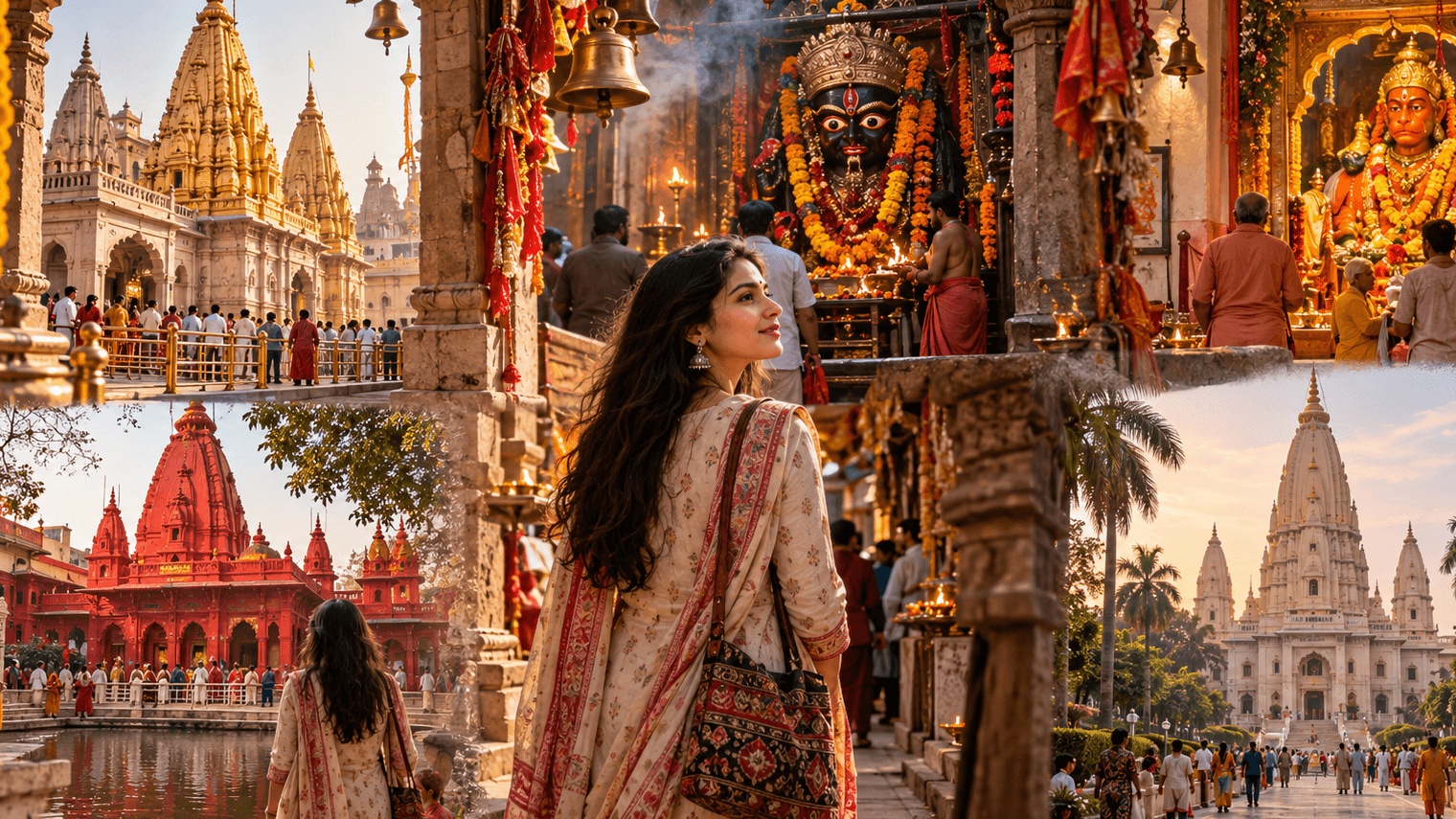
I had been to Banaras before, but this time I wanted to experience the city differently.
Instead of trying to cover every famous ghat, café and market, I decided to spend a few days visiting temples, without making a strict checklist out of it. I simply wanted to walk through the city, stop wherever I felt drawn to, sit quietly when I wanted to, and experience Banaras at its own pace.
What surprised me was how different every temple felt.
Some were crowded and energetic, some peaceful, some intense, and some made me want to sit there much longer than I had planned.
By the end of my temple trail, I realised that visiting temples in Banaras is not really about seeing a collection of religious places. Each one reveals a slightly different side of the city.
Starting with Kashi Vishwanath
Of course, I began with Shri Kashi Vishwanath Temple.
Even before reaching the temple, there is a certain excitement in the narrow lanes surrounding it. Shops selling flowers, prasad, rudraksha malas and small brass idols line the way, while people constantly move past you chanting “Har Har Mahadev”.
The closer I got, the more energetic everything seemed to become.
I had heard so much about Kashi Vishwanath that I wondered whether the actual experience could live up to the image I had created in my mind.
It did—but in a different way.
Because of the crowd, the darshan itself happened quickly. There wasn't really enough time to stand quietly and admire everything. But somehow those few moments in front of Baba Vishwanath felt surprisingly powerful.
After coming out, I didn't immediately leave.
I walked around the corridor for some time and found a quieter spot to sit.
That was probably my favourite part of the visit.
From there, I could simply observe people—elderly couples who had probably waited years to come here, families carrying small children, local devotees who seemed completely familiar with the place, and travellers like me trying to absorb everything happening around them.
There was something beautiful about knowing that people had been coming to Kashi with the same devotion for generations.
Meeting the Kotwal of Kashi at Kaal Bhairav Temple
One thing several people told me was:
“If you are visiting Kashi, you should visit Baba Kaal Bhairav.”
So that became my next stop.
The experience here felt completely different from Kashi Vishwanath.
The lanes were narrower, the temple felt more traditional, and there was an intensity to the atmosphere that I noticed almost immediately.
Kaal Bhairav is traditionally regarded as the Kotwal, or guardian, of Kashi, and when you hear locals speak about him, it almost feels as though Baba Bhairav is not simply a deity in a temple but someone actively watching over the city.
There was a crowd when I visited, but the whole process felt very local.
I remember standing in line and watching people carrying flowers, oil and prasad. Unlike some larger temples, this visit somehow made me feel like I had stepped inside the everyday religious life of Banaras.
It wasn't grand.
It was intense, old and deeply rooted.
And strangely, I loved that.
A Softer Morning at Sankat Mochan
My visit to Sankat Mochan Hanuman Temple had a completely different mood.
I went in the morning, and compared with some of the temples I had already visited, I felt much calmer here.
There is something comforting about Hanuman temples anyway, but Sankat Mochan had an especially warm atmosphere.
People were sitting quietly after darshan. Some were reciting prayers, some were simply watching the temple activities, and others were distributing or carrying the famous besan laddoo prasad.
And yes, I was warned about the monkeys.
I kept my belongings close and avoided carrying food openly, although seeing monkeys casually moving around the temple surroundings somehow made the whole experience even more memorable.
I didn't feel like rushing after my darshan.
I sat there for a while.
Maybe it was the morning air or maybe it was simply the atmosphere, but Sankat Mochan was one of those places where I felt peaceful without really trying to be.
Durga Kund and the Red Temple That Immediately Catches Your Eye
From Sankat Mochan, I later made my way towards Durga Temple at Durgakund.
You notice the temple almost immediately because of its striking red colour.
There is a very different energy here.
People were constantly coming and going, bells could be heard from inside, and the nearby kund gave the whole area its own character.
As a woman, I also found myself quietly observing other women visiting the temple—some carrying small children, some praying with their families and some standing alone with folded hands.
It reminded me that temples are not always places where people come looking for some grand spiritual revelation.
Sometimes you come carrying very ordinary worries.
Something about work.
Something about family.
Something about your future.
Maybe you don't even say those things out loud.
You simply stand there for a few moments and leave feeling slightly lighter.
That was how Durga Temple felt to me.
Finding Space and Silence at the Vishwanath Temple in BHU
After spending so much time navigating the crowded old lanes of Banaras, visiting Shri Vishwanath Temple inside Banaras Hindu University, often called New Vishwanath Temple or Birla Temple, almost felt like entering another city.
Suddenly there were broad roads, trees, students cycling around campus and far more open space.
The temple itself is tall, spacious and noticeably quieter than many temples in the older parts of Banaras.
I slowly walked around the temple and then simply sat there.
Nobody seemed to be in a hurry.
Students were sitting nearby, families were walking around and a few visitors were quietly reading inscriptions inside the temple.
After several days of walking through crowded lanes, hearing bells, navigating queues and constantly moving through people, I realised how much I appreciated this silence.
Both Vishwanath temples gave me completely different experiences.
The old Kashi Vishwanath made me feel the intensity of Banaras.
The BHU Vishwanath Temple gave me space to process it.
Discovering the Older Side of Kashi at Kardameshwar Mahadev
One temple that felt especially interesting was Kardameshwar Mahadev Temple in Kandwa.
Unlike Kashi Vishwanath or Sankat Mochan, this was not a place where I felt surrounded by large numbers of tourists.
The surroundings felt quieter and older.
This was the kind of place that reminded me how many layers Banaras actually has.
Most visitors know the famous temples, but once you start moving away from the busiest areas, you begin discovering places that have quietly remained part of Kashi's spiritual landscape for generations.
Standing there, I found myself thinking about how impossible it would be to truly “finish” exploring Banaras.
Behind every temple you know, there seems to be another temple, another story, another lane and another piece of history waiting somewhere nearby.
What Stayed With Me
After visiting so many temples, people naturally ask me:
“Which one did you like the most?”
And I genuinely don't know how to answer that.
Kashi Vishwanath gave me that unmistakable feeling of finally being in Kashi.
Kaal Bhairav felt intense and mysterious.
Sankat Mochan made me peaceful.
Durga Kund felt warm and personal.
BHU Vishwanath gave me silence.
Kardameshwar Mahadev showed me a quieter and older side of Banaras that I probably would have missed on a shorter trip.
So I don't think I have one favourite.
What I loved was how each place made me feel something different.
Banaras Is Better When You Don't Rush It
One thing I would tell any woman—or really anyone—planning a temple trail in Banaras is not to turn it into a race.
It is tempting to search online for “10 temples to visit in Varanasi in one day” and spend the entire day moving from one place to another.
But I think that takes away some of the magic.
Wear comfortable clothes.
Carry only what you need.
Keep water with you.
Be prepared for queues, narrow lanes and sudden changes in plans.
And most importantly, leave some empty space in your day.
Sit somewhere after darshan.
Have a chai.
Talk to a local shopkeeper.
Walk through a lane that looks interesting.
Buy prasad from a tiny shop.
Listen to temple bells without checking the time.
Banaras doesn't always reveal itself through monuments or famous places.
Sometimes it happens while you're sitting quietly on a temple step watching the city move around you.
I Came Back With More Than Photographs
When I look back at my temple visits in Banaras, I don't remember every architectural detail.
I remember moments.
The sound of “Har Har Mahadev” while walking towards Kashi Vishwanath.
Holding my belongings tightly after somebody warned me about monkeys near Sankat Mochan.
The striking red walls of Durga Temple.
The surprising silence inside the BHU campus.
The narrow lanes.
The flowers.
The bells.
The smell of incense.
The women walking barefoot towards a temple with more energy than I had after an entire day of sightseeing.
And somewhere between all of this, Banaras started feeling less like a destination I had come to visit and more like a place I was slowly getting to know.
Maybe that is what makes visiting temples here so special.
You begin by searching for temples.
But somewhere along the way, you start discovering Kashi.
THE CONVERSATION CONTINUES
Story Comments
A question, a local tip, or a memory of your own. There’s room for your voice here.
Every perspective adds a little more.
Sign in to share yours, ask a question, or reply to the community.