
Sarnath Heritage Walk
Explore Sarnath on a heritage walk covering ancient stupas, the museum, Buddhist temples, Jain heritage and Sarangnath Mahadev near Varanasi.
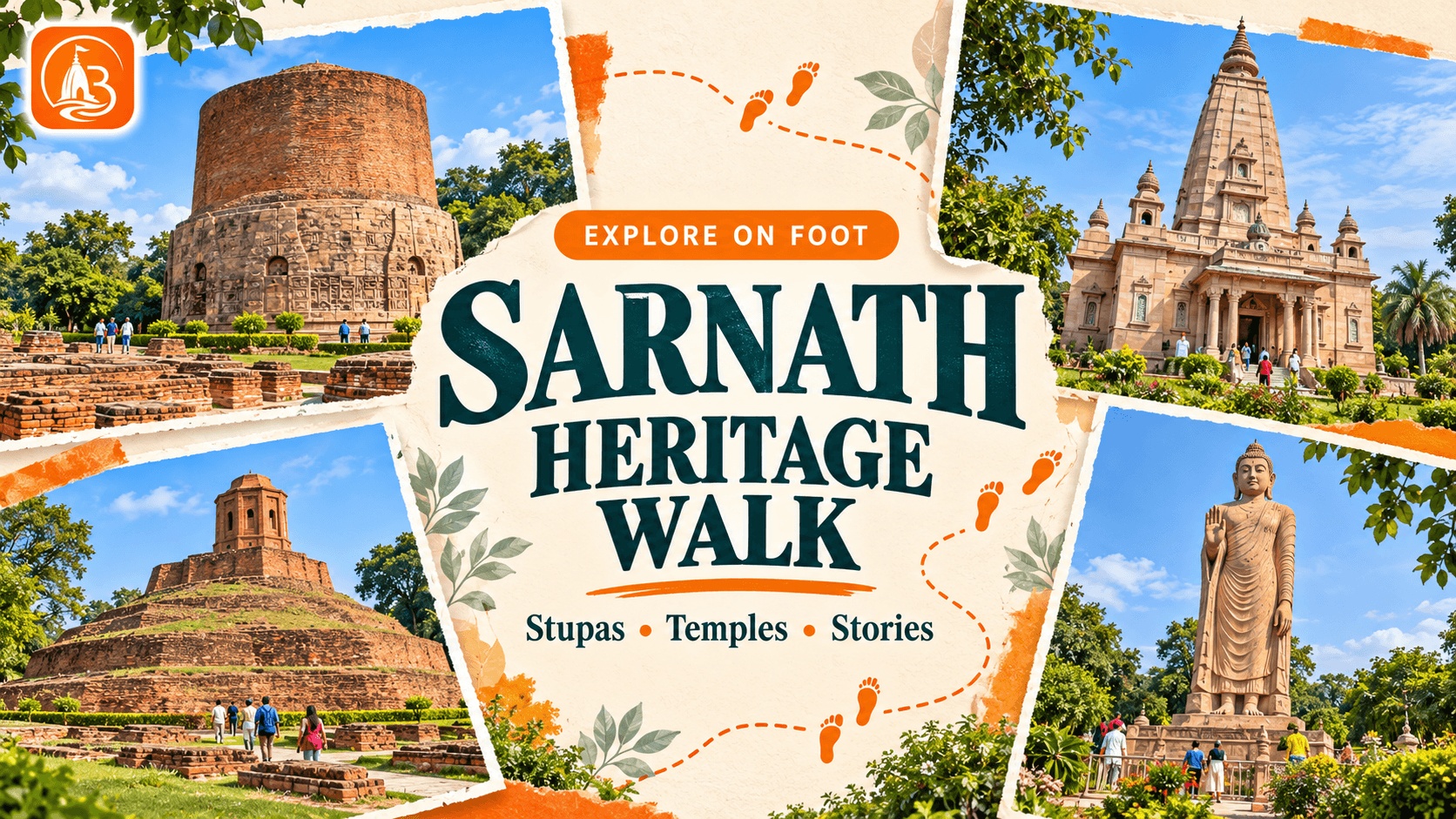
A Sarnath Heritage Walk brings together ancient Buddhist monuments, archaeological discoveries and the temples of a living pilgrimage town. Located northeast of central Varanasi, Sarnath is associated with the Buddha’s first sermon after his enlightenment at Bodh Gaya. Walking through the area helps connect that history with the monasteries and places of worship that continue to draw pilgrims today.
The experience extends beyond Dhamek Stupa. A well-planned visit can include Chaukhandi Stupa, the archaeological museum, excavated monastery remains, Mulagandha Kuti Vihara, the Thai Temple and standing Buddha statue, international Buddhist temples, the Jain temple and Sarangnath Mahadev.
Plan your Sarnath Heritage Walk
Detail | Suggested plan |
|---|---|
Activity | Self-guided or guided heritage walk |
Starting point | Chaukhandi Stupa; alternatively, the museum for a shorter visit |
Core visit | Allow approximately 4–5 hours |
Extended visit | Allow approximately 6–8 hours, including breaks and selected temple interiors |
Walking conditions | A mix of monument paths, temple compounds and public roads |
Transport option | Use a short auto or e-rickshaw ride between separated clusters |
Best season | Generally October–March; start early on warmer days |
Important closure | Sarnath Archaeological Museum is closed on Fridays |
These durations are planning estimates, not fixed tour timings. Visiting every temple slowly may require a second visit. Uttar Pradesh Tourism also lists a five-hour Sarnath heritage walk, although its itinerary covers fewer stops than this extended guide.
A suggested route through Sarnath
Begin at Chaukhandi Stupa, adding the nearby Garden of Spiritual Wisdom if it is open. Continue towards the Thai Temple and standing Buddha, followed by the Sarnath Archaeological Museum.
Next, explore the main archaeological complex, including Dhamek Stupa, Dharmarajika Stupa remains, the Ashoka Pillar remains and excavated monasteries. Visit the Digambar Jain Temple and Mulagandha Kuti Vihara with its Bodhi tree area around this central cluster.
Use the remaining time for the Japanese, Chinese, Tibetan and Burmese temples, then include Sarangnath Mahadev Temple and its kund as an extension.
Treat this as a flexible sequence. Confirm entrances and current temple access on a map before starting, and group the international temples according to which are open. Chaukhandi and some outer stops involve additional road walking; a short ride can make the day more comfortable.
1. Chaukhandi Stupa
Chaukhandi Stupa provides an introduction to Sarnath’s Buddhist history. It is traditionally associated with the place where the Buddha met the five ascetics who became his first disciples. Its raised brick structure and later octagonal tower give it a different appearance from Dhamek Stupa.
Walk along the permitted paths and observe how the monument combines different periods of construction. The Ancient Buddhist Site of Sarnath, inscribed on UNESCO’s World Heritage List in 2026, comprises Chaukhandi Stupa and the main archaeological remains as two component parts. The designation does not extend automatically to every modern temple in the town.
Suggested time: 20–30 minutes.
Nearby: Garden of Spiritual Wisdom
Located behind Chaukhandi Stupa, this garden uses exhibits and illustrated displays to introduce Indian spiritual ideas. It makes a useful additional stop for visitors who enjoy reading and quiet outdoor spaces. Check current opening arrangements before including it in your schedule.
Suggested additional time: 20–30 minutes.
2. Wat Thai Temple and the standing Buddha statue
The Thai Temple, commonly called Wat Thai Sarnath or Thai Buddha Vihar, introduces the international Buddhist connections visible throughout Sarnath.
Its grounds are known for an approximately 80-foot standing Buddha statue. Allow time to view the statue and temple architecture, while respecting areas reserved for prayer. The statue and temple belong to the same stop; they do not need to be planned as separate attractions.
This is a good place to begin noticing how modern Buddhist communities express their traditions through architecture, images and worship.
Suggested time: 20–30 minutes, subject to access.
3. Sarnath Archaeological Museum
The museum gives context to the monuments outside. Its collection includes the original Lion Capital of Ashoka, whose four-lion composition was adopted as India’s State Emblem, alongside sculptures and other finds recovered from Sarnath.
Look for the celebrated Gupta-period image of the Buddha preaching his first sermon. The wheel, deer and disciples represented on its pedestal connect the sculpture with the history of the place you are exploring.
Allow enough time to read the labels. Visiting the museum before the ruins can help you understand what once occupied the excavated foundations.
Suggested time: 45–60 minutes.
Visitor information: The museum’s own website lists 9 AM–5 PM, with a Friday closure, and an entry fee of ₹5 per person, with free entry for children below 15. Some tourism pages list a 10 AM opening, so confirm before an early visit. Museum admission is separate from the archaeological site. Follow the current photography, bag and security rules at the entrance.
4. Dhamek Stupa and the archaeological complex
Set aside a substantial part of the walk for the main archaeological grounds. Several major landmarks are within this complex, so explore them together.
Dhamek Stupa
The large cylindrical Dhamek Stupa is Sarnath’s most recognisable monument. It is associated with the Buddha’s first teaching at Sarnath and is particularly notable for the floral and geometric carving on its lower stone surface.
Walk around it on the designated paths and leave space for pilgrims praying or circumambulating.
Dharmarajika Stupa remains
The surviving foundations of Dharmarajika Stupa help explain the scale of Sarnath’s earlier sacred landscape. Unlike Dhamek, this monument survives as archaeological remains rather than a tall standing structure.
Ashoka Pillar remains
The pillar fragments belong to the same historical setting as the Lion Capital displayed in the museum. Seeing both helps connect the original monument with the object preserved indoors.
Ancient temple and monastery foundations
Continue through the excavated remains to understand Sarnath as a former centre of monastic life. Look for the remains identified as the ancient Mulagandha Kuti shrine, alongside monastery foundations. These ancient remains are distinct from the modern Mulagandha Kuti Vihara visited later in the walk.
Use the site boards or a knowledgeable guide to identify the structures. Stay on permitted routes and avoid climbing the ancient brickwork.
Suggested time for the whole complex: 60–90 minutes.
5. Shri Digambar Jain Temple
Near the main archaeological area, the Digambar Jain Temple introduces another important religious tradition associated with Sarnath.
The temple is dedicated to Shreyansnath, the 11th Jain Tirthankara. Sarnath and the nearby Singhpur area hold significance in Jain pilgrimage traditions associated with him. The present temple dates to 1824.
Include a quiet visit to the shrine if it is open. Observe the temple’s own rules on footwear, photography and entry.
Suggested time: 15–20 minutes.
6. Mulagandha Kuti Vihara and the Bodhi tree area
Mulagandha Kuti Vihara connects Sarnath’s ancient associations with the modern revival of Buddhist pilgrimage. Established through the Maha Bodhi Society of India and the efforts of Anagarika Dharmapala, the vihara opened in 1931.
Inside, wall paintings by Japanese artist Kosetsu Nosu depict episodes from the Buddha’s life. This is a place to slow down and observe the artwork as well as the worship taking place.
Visit the nearby Bodhi tree area, which has a historical connection with the sacred tree tradition of Anuradhapura in Sri Lanka. Ask locally about public prayers if you would like to attend; do not assume a fixed ceremony time.
Suggested time: 30–45 minutes.
7. Japanese, Chinese, Tibetan and Burmese temples
Sarnath’s international temples show how Buddhist communities remain connected to this pilgrimage site. Include the following in an extended walk, adapting the order to their locations and opening arrangements.
Place | Focus for your visit |
|---|---|
Japanese Temple | Observe the shrine, Buddhist imagery and architectural details |
Chinese Temple | Explore its distinct temple setting and devotional art where access is permitted |
Tibetan Buddhist Temple or monastery | Notice the imagery and religious objects; respect prayer and residential areas |
Burmese Buddhist Temple | Include the Myanmar Buddhist connection in your exploration of Sarnath |
These are working religious institutions. Public access to compounds and prayer halls can differ, and a closed entrance should be respected.
For a half-day visit, choose one or two. For the extended route, allow approximately 60–90 minutes plus connecting travel, adjusting for actual access and the time you spend inside.
8. Sarangnath Mahadev Temple and Kund
Sarangnath Mahadev adds a Hindu place of worship to the walk. Dedicated to Shiva, the temple is associated with the adjoining Sarangnath Kund.
This stop broadens the visit beyond the Buddhist monuments and introduces another part of Sarnath’s local religious life. It is particularly suitable for visitors interested in understanding the area across traditions.
Suggested time: 20–30 minutes, plus travel from your previous stop.
Additional places for a longer visit
Vajra Vidya Institute is a further option for travellers interested in Tibetan Buddhist learning. It is a monastic institution, so enquire about visitor access rather than assuming the campus is open for sightseeing.
Sarnath’s historical name Mrigadava, or Deer Park, refers to its ancient sacred landscape. References to the modern deer enclosure describe a separate visitor facility; confirm its current access if you want to include it.
Choose a version that suits your day
For approximately four hours: Prioritise the museum, archaeological complex, Mulagandha Kuti Vihara and one nearby temple. Begin at the museum or central visitor area.
For approximately five hours: Add Chaukhandi Stupa and the Thai Temple, using a short ride where helpful.
For a full day: Follow the broader route, including the Jain temple, international temples and Sarangnath Mahadev. Take a lunch break and keep the final stops flexible.
These are suggested formats rather than timed departures. Temple closures, museum visits and personal walking pace can change what fits comfortably.
Tickets, guides and getting there
Sarnath is accessible by road from Varanasi. A cab or auto is practical for reaching the starting point; arrange a clear pickup location if your walk ends elsewhere.
There is no single ticket covering every place in this suggested route. Budget separately for applicable monument and museum admissions, transport, refreshments and an optional guide. Confirm the current archaeological-site and Chaukhandi charges through the official ticketing arrangements.
You can explore independently, or hire a guide to explain the excavated remains, Buddhist art and religious history. Before booking, agree on the places covered, duration, language, total price and whether entry tickets or transport are included.
Best time, accessibility and visiting etiquette
The cooler months are generally more comfortable for an extended outdoor walk. Start early in warmer weather and plan shaded breaks. Winter fog and monsoon rain can affect walking conditions.
This route includes outdoor paths, steps, public roads and places with differing access arrangements. Visitors with limited mobility should check each entrance and use transport between clusters. A shorter museum-and-monuments visit may be more manageable than the complete circuit.
Carry drinking water, sun protection and comfortable footwear. Dress modestly, remove shoes where required, keep voices low in prayer spaces, and ask before photographing people or religious ceremonies.
Leave time to pause. Looking closely at a sculpture, reading a site board or sitting quietly in an accessible temple courtyard can make the walk more rewarding than adding another stop.
THE CONVERSATION CONTINUES
Conversations from the city
A question, a local tip, or a memory of your own. There’s room for your voice here.
Every perspective adds a little more.
Sign in to share yours, ask a question, or reply to the community.