Ramnagar Ramlila
“ Planning to attend Ramnagar Ramlila? Discover what makes Varanasi's month-long moving Ramlila unique, how the performances work, what to carry, where to plan your transport and what first-time visitors should know. ”
Ramnagar Ramlila is unlike an ordinary Ramlila staged in a park or auditorium. For nearly a month, different parts of Ramnagar become Ayodhya, Janakpur, Chitrakoot, Panchvati and Lanka, while performers and spectators move through the town together. If you are planning to experience the Ramnagar Ramlila, this guide explains what makes it special, how an evening works and what you should know before going.
For someone visiting for the first time, the most important thing to understand is that Ramnagar itself becomes the stage.
Ramnagar Ramlila at a glance
The Ramnagar Ramlila takes place in Ramnagar, on the eastern side of the Ganga opposite Varanasi. Rather than compressing the Ramayana into a single evening, the story unfolds across roughly a month.
The broader Ramlila tradition is inscribed on UNESCO's Representative List of the Intangible Cultural Heritage of Humanity. UNESCO specifically identifies Ramnagar as one of the representative Ramlila traditions of northern India and notes that, unlike many shorter Ramlilas, the Ramnagar version can continue for an entire month.
Why is the Ramnagar Ramlila so different?
Imagine going to see a play where there is no permanent stage.
Instead, an entire town has been turned into the setting.
That is the essential idea behind the Ramnagar Ramlila.
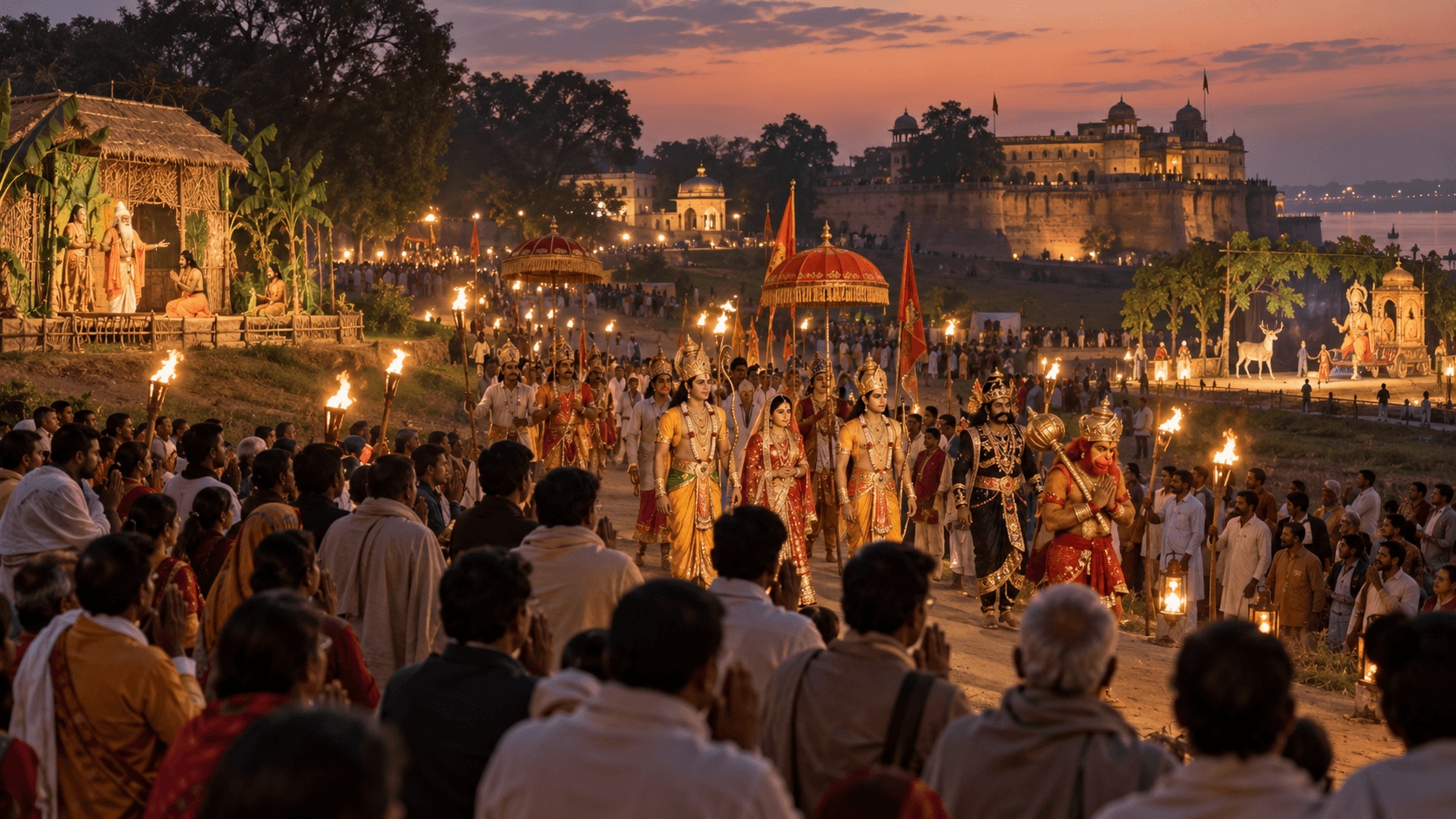
Different physical locations represent different places in the Ramcharitmanas. One area may represent Ayodhya, another Janakpur, another Chitrakoot, Panchvati or Lanka. As Rama's journey moves from one place to another in the story, the performance itself moves through Ramnagar.
The Government of India's tourism portal describes the event as a 31-day celebration in which spectators journey between different locations as the story progresses. Government cultural documentation likewise notes that the audience moves with the performers from one setting to another.
So you are not simply watching the Ramayana.
For a few hours, you are physically following its journey.
That is what gives Ramnagar Ramlila its extraordinary atmosphere.
How does an evening at Ramnagar Ramlila work?
Do not arrive expecting rows of numbered chairs, a large LED screen and a conventional theatre stage.
The experience is much more fluid.
You first need to identify where that evening's episode is being performed. Depending on the story, spectators may gather in an open ground, near a traditional structure or at one of the locations that represents a place from the Ramayana.
Once the performance starts, pay attention to the people around you. Regular attendees often know exactly when the action is about to shift.
When a scene moves, much of the crowd moves with it.
You may find yourself walking alongside hundreds or thousands of spectators before gathering again at the next setting.
This movement is not an inconvenience added to the performance. It is part of the Ramnagar Ramlila itself.
Traditional presentation is central to the experience, and visitors should not expect the lighting, amplification or visibility of a modern theatrical production. That simplicity is part of what has preserved the distinctive character of the event.
Which Ramlila episode should a first-time visitor see?
There is no single correct choice.
If you already know the Ramayana well, you might choose an episode you have a particular connection with. Major moments across the cycle include episodes around Ram Janma, Dhanush Yagya, Van Gaman, the forest period, Lanka-related episodes, Ravana Vadh and the later return and coronation sequences.
A major episode can provide an impressive introduction because of the crowds, movement and scale involved.
But quieter evenings have an advantage too.
With fewer distractions, it can be easier to observe the dialogue, rituals and relationship between performers and long-time spectators. If your goal is to understand the tradition rather than simply photograph its biggest moments, an ordinary evening can be equally rewarding.
For 2026, however, choose the episode only after checking the official or locally issued programme. We will update this guide when a reliable day-by-day schedule becomes available.
Getting to Ramnagar
Ramnagar lies across the Ganga from the main Varanasi city.
For most visitors staying around Assi, Lanka, Bhelupur or central Varanasi, travelling by road is the safest option to plan around. Festival traffic can make travel times considerably less predictable than the distance on a map suggests.
Try to reach Ramnagar well before the performance you want to see rather than calculating your journey around the exact starting time.
Your return journey deserves even more planning.
Large crowds may leave around similar times, transport can become difficult to find, and the place where you finish watching the performance may not be exactly where you began.
If travelling by auto, cab or private vehicle, agree on a clear pickup point before separating from your driver.
Visitors sometimes consider crossing the Ganga by boat, but do not make your entire plan dependent on river transport unless you have checked current operating conditions, timing and availability for that particular evening.
What should you carry?
Ramnagar Ramlila rewards people who arrive prepared but travel light.
Comfortable footwear is probably the most important thing to bring. You may spend considerable time standing and walking between performance locations.
Carry a bottle of water, especially on warmer evenings. September and October conditions can also be unpredictable, so light rain protection can be useful.
A charged phone is important for coordinating with companions and arranging your return journey. A small power bank is worth carrying if you expect to stay for several hours.
A compact torch can also help on darker stretches, but use it carefully. Avoid shining bright lights towards performers or other spectators.
And keep your luggage minimal.
A backpack filled with unnecessary belongings quickly becomes uncomfortable when you are moving through a dense crowd.
Visiting with children or elderly family members
Families can absolutely experience Ramnagar Ramlila, but it helps to understand the physical nature of the event.
There may be prolonged standing.
Some stretches may involve considerable walking.
Outdoor surfaces can be uneven, dusty or muddy depending on weather conditions.
Dense crowds can also make it surprisingly easy for family members to become separated.
If you are visiting with children or elderly companions, decide on a simple meeting point before entering the busiest part of the crowd. Avoid relying entirely on phone calls; mobile connectivity can become less dependable when large numbers of people gather in one place.
You also do not have to follow every movement of the performance.
For visitors with limited mobility, experiencing one portion comfortably is better than trying to keep pace with the entire crowd.
Photography at Ramnagar Ramlila
For photographers, Ramnagar Ramlila can be remarkable.
Traditional costumes, crowds, processions, open spaces and atmospheric evening scenes create countless possibilities.
But this is also where visitors need to exercise restraint.
Ramnagar Ramlila is not simply a historical re-enactment staged for tourists. For many people attending, it is an act of devotion and a living religious tradition.
Avoid using flash close to performers.
Do not walk into the performance area simply to obtain a better angle.
Do not stand in front of seated spectators for extended periods.
And never obstruct performers, processions or the movement of the crowd.
Sometimes the strongest photograph will come from stepping away from the main scene: families reading along, spectators waiting in silence, people walking between locations, children watching from shoulders, or the transformation of an ordinary Ramnagar street into part of the Ramayana landscape.
Being unobtrusive usually produces better photographs anyway.
Why Ramnagar Ramlila is worth experiencing at least once
Varanasi has many events that can be understood from a single viewpoint.
Ramnagar Ramlila is different.
To experience it properly, you have to participate in its geography.
You wait.
You listen.
You walk.
You lose sight of the action for a moment and then find it again among a crowd moving towards another part of Ramnagar.
The boundaries between performer, spectator, town and story become unusually thin.
That quality has helped make Ramnagar one of the most distinctive examples of the Ramlila tradition. UNESCO describes Ramlila as a combination of narration, recital, dialogue and community participation, with Ramnagar among its representative centres.
For a traveller, it offers something increasingly rare: an event that cannot really be understood through a stage photograph or a short video clip.
You need to follow it.
Once the organisers' complete programme is available, this section should be updated with date, episode, location, reporting time and any special transport advice rather than copying dates from previous years.