
Ghats of Banaras
Explore the ghats of Banaras, from Assi to Adi Keshav, with their history, sacred traditions, architectural landmarks and practical tips for your visit.
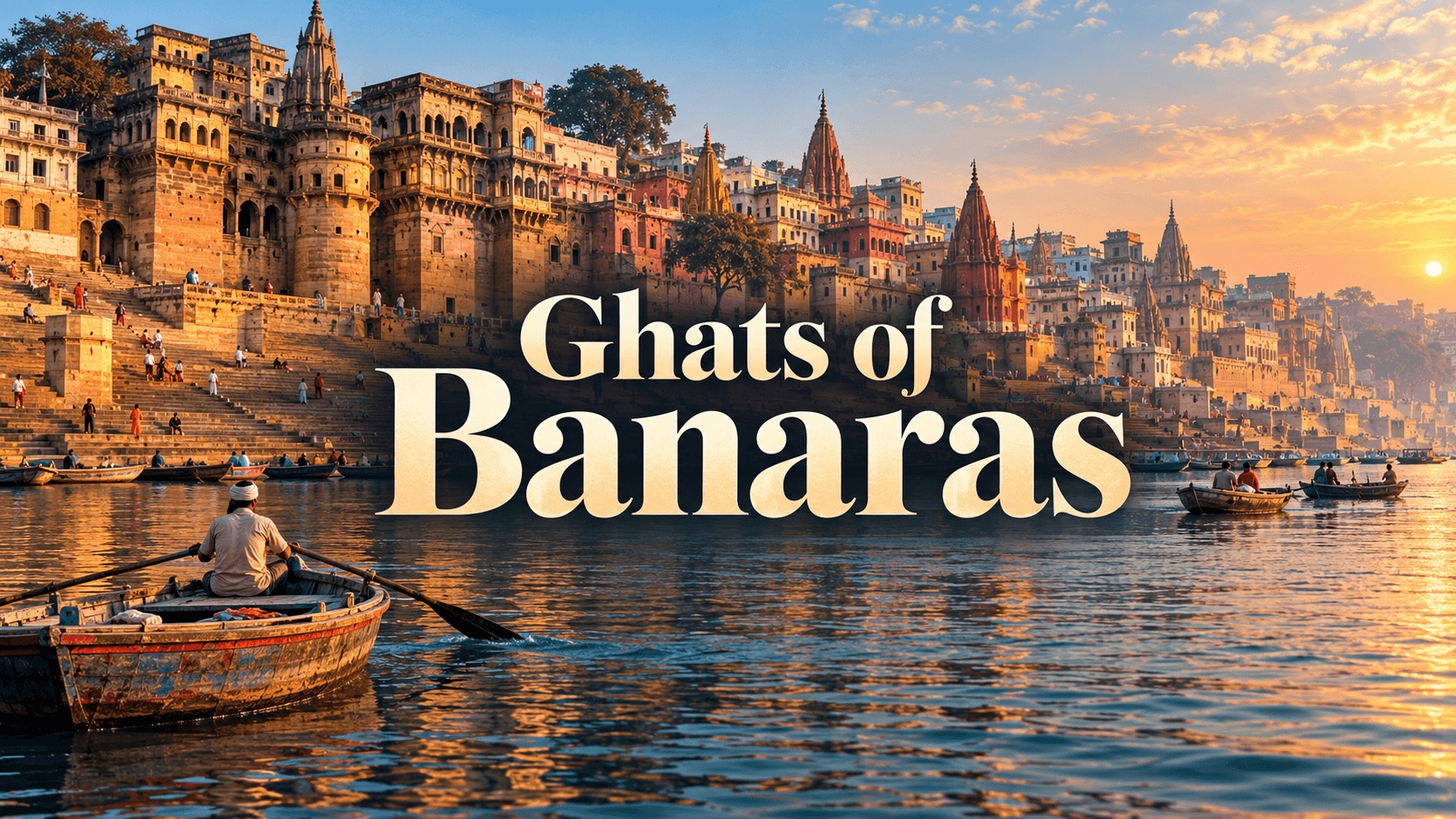
Banaras is often introduced through its ghats: the flights of steps that connect the city to the Ganga. Along this riverfront, people come to pray, bathe, practise yoga, work, meet friends and perform the last rites of loved ones. Temples, palaces, monasteries and narrow lanes rise behind the steps, making each stretch part of a larger neighbourhood.
This guide to the ghats of Banaras looks beyond the most photographed landmarks. It explains the names, associations and character of the smaller ghats as well as familiar places such as Assi, Dashashwamedh, Kedar and Panchganga.
How many ghats does Banaras have?
There is no single count used consistently across sources. The 2021 riverfront heritage submission published on UNESCO's Tentative List website names 84 ghats, while the Varanasi Smart City website describes 88. Some adjoining stretches are counted separately in one inventory and grouped together in another; names and boundaries can also overlap.
This guide uses the 84-name heritage inventory as a historical framework and also covers Namo Ghat, the redeveloped Khidkiya Ghat, as a modern riverfront destination. The selection introduces the principal historic sequence and its smaller named stretches, while recognising that other ghats and newer extensions exist beyond it.
The traditional entries broadly follow the riverfront from Assi towards Adi Keshav. Their numbers are reading references, not official ghat numbers.
How the ghats became the face of Banaras
The sacred associations of the riverfront are older than many of the stone structures seen today. Successive patrons built, enlarged and repaired the steps, temples, residences and pilgrim accommodation over different periods.
Maratha families, rulers from Rajasthan, estates in Bengal and Bihar, the royal house of Banaras and patrons from Nepal all contributed to this landscape. Their buildings help explain why architectural styles and religious institutions change as one moves along the river.
The ghats also form a working part of the city. Boatmen, priests, traders, students, residents and pilgrims use the same river edge for different purposes. Understanding this everyday life is as important as knowing the history of its palaces.
Assi to Panchkota: the southern riverfront
1. Assi Ghat
Assi is a major gathering place at the southern end of the traditional ghat circuit. It is associated with the former meeting of the Assi watercourse and the Ganga. Visitors come for sunrise, boat departures and Subah-e-Banaras, which brings together morning worship, music and yoga. Check the day's programme locally.
2. Ganga Mahal Ghat I
Immediately north of Assi, this ghat takes its name from the Ganga Mahal palace associated with the royal house of Banaras. Its imposing river-facing building is the principal landmark. It is separate from Ganga Mahal Ghat II farther north.
3. Rewa Ghat
Also written Riva, Rivan or Reewa, this ghat is associated with Rewa Kothi and the former Rewa estate. The palace property later became connected with Banaras Hindu University. Its substantial stone frontage makes it a useful architectural stop between Assi and Tulsi.
4. Tulsi Ghat
Tulsi Ghat commemorates the poet-saint Goswami Tulsidas, author of the Ramcharitmanas. The surrounding temples, monastery and akhara connect the site with devotional literature, worship and physical training. Its cultural importance extends beyond the steps themselves to the institutions and performance traditions of the neighbourhood.
5. Bhadaini Ghat
Bhadaini is distinguished by its historic waterworks installation, which also gives it the name Jalkal Ghat. It illustrates the practical relationship between Banaras and the Ganga: the riverfront has supported the city's water infrastructure as well as its religious life.
6. Janaki Ghat
Also spelled Janki, this ghat is named for Janaki, another name of Sita. Its development is associated with patronage from the Sursand estate in Bihar. Temples above the steps connect this modest stretch with the devotional landscape of southern Banaras.
7. Mata Anandamayi Ghat
This ghat is named after the twentieth-century spiritual teacher Anandamayi Ma. The ashram above it is central to its identity. It represents the contribution of more recent spiritual institutions to a riverfront often discussed only through ancient traditions and royal patronage.
8. Vachcharaj Ghat
Found under spellings such as Vachchharaj, Vacharaj and Bachraj, this ghat has strong Jain associations. It is named after a Jain patron, while nearby shrines connect the neighbourhood with Suparshvanath, the seventh Tirthankara, whose birthplace is traditionally identified here.
9. Jain Ghat
Jain Ghat developed as a separately named stretch of the Vachcharaj riverfront. Its identity is closely tied to nearby Jain temples and the community's pilgrimage traditions. Together, these two ghats introduce an important part of Banaras's religious heritage beyond its better-known Shiva shrines.
10. Nishadraj Ghat
Named for Nishadraj Guha of the Ramayana, this ghat is closely associated with the Nishad boatmen community. A Nishadraj temple reinforces that connection. It is a useful place to understand how community identity and river-based livelihoods have shaped ghat names.
11. Prabhu Ghat
Prabhu Ghat is associated with Maharaja Prabhu Narayan Singh of Banaras. It forms part of the southern neighbourhood riverfront, where small shrines, homes and everyday activity matter as much as large monuments. Historical accounts differ on aspects of its early construction.
12. Panchkota Ghat
Also called Panchakot Ghat, this stretch is associated with the Panchakot estate of Bengal. The residence above the steps reflects a familiar pattern in Banaras: patrons from elsewhere in India establishing a riverside base for pilgrimage and religious life.
Chet Singh to Kedar: palaces, akharas and Shiva worship
13. Chet Singh Ghat
The fort-like palace above this ghat is one of the riverfront's most recognisable buildings. The site is associated with the 1781 confrontation between Raja Chet Singh and Warren Hastings. Its towers and river-facing walls make it an important stop for understanding the political history of Banaras.
14. Niranjani Ghat
Niranjani Ghat takes its name from the Niranjani Akhara, a Shaiva ascetic order. A Kartikeya shrine within the akhara compound adds to its religious significance. The ghat belongs to a stretch where monastic institutions have helped shape the riverfront's identity.
15. Mahanirvani Ghat
This ghat is associated with the Mahanirvani Akhara and its ascetic traditions. Its significance lies mainly in the religious institutions above the steps. Visitors should remember that an akhara or monastery is an active institution, and access to its inner spaces may be restricted.
16. Shivala Ghat
Shivala combines palatial riverfront buildings, Shiva worship and longstanding South Indian religious connections. The nearby Brahmendra Math forms part of this institutional landscape. It is best explored alongside Chet Singh and the neighbouring akhara ghats to understand the wider Shivala area.
17. Gulariya Ghat
Gulariya, also written Gularia, is a small stretch near Shivala. Its name is traditionally linked to a gular tree. It is an example of how a local natural feature could give a distinct identity to a comparatively small section of riverbank.
18. Dandi Ghat
Dandi Ghat is associated with the Dandi Swamis, ascetics who carry a staff, or danda. A nearby monastery explains the name. Its history reflects the role of religious communities in establishing places to stay, worship and reach the river.
19. Hanuman Ghat
Formerly known as Rameshwar Ghat, Hanuman Ghat is associated with temples, ascetic institutions and akhara traditions. The surrounding neighbourhood has strong South Indian connections. Its religious identity includes both Hanuman worship and the older Rameshwar association.
20. Prachin Hanuman Ghat
Also called Old Hanuman Ghat, this adjoining stretch is listed separately in the heritage inventory. It shares the wider area's temple and monastic setting. The neighbourhood is associated with Vallabhacharya, the devotional teacher connected with the Pushtimarg tradition.
21. Karnataka Ghat
Also known as Mysore Ghat, Karnataka Ghat developed through the patronage of the Mysore estate. Its pilgrim accommodation reflects the longstanding movement of devotees between southern India and Kashi. It is distinct from the adjoining Hanuman and Harishchandra ghats.
22. Harishchandra Ghat
Harishchandra is one of Banaras's two principal cremation ghats. Its name recalls the legendary King Harishchandra, remembered for his commitment to truth and duty. The site includes traditional cremation practices and an electric crematorium. Visitors should give funeral parties space and avoid photographing last rites.
23. Lali Ghat
Lali Ghat is a smaller stretch associated in local tradition with Lali Baba and the Gudaradas Akhara. Its monastic connections are more useful to understanding the place than its size. Historical accounts of its naming and construction vary.
24. Vijayanagaram Ghat
Vijayanagaram Ghat is associated with the estate of that name in present-day Andhra Pradesh. The Swami Karpatri Ashram above it is an important landmark. The ghat adds to the South Indian institutional connections visible along this part of the riverfront.
25. Kedar Ghat
Kedar is an important centre of Shiva worship, taking its name from the Kedareshwar Temple above the steps. The shrine has a strong following among South Indian pilgrims and is religiously associated with Kedarnath. The painted temple frontage, bathing steps and surrounding lanes make this a rewarding area to explore.
Chauki to Sheetla: neighbourhood shrines and palace fronts
26. Chauki Ghat
Chauki Ghat is particularly associated with a peepal tree and stone serpent figures near the upper steps. These connect it with traditions of Naga worship. It is a useful reminder to look above the river's edge, where small shrines often explain a ghat's significance.
27. Kshemeshwar Ghat
Also found as Kshemeshwar, Ksemesvara or Someshwar, this ghat is associated with Kshemeshwar Mahadev. Connections with the Sri Kumaraswamy Mutt place it within the wider network of South Indian religious institutions around this part of Banaras.
28. Mansarovar Ghat
Mansarovar Ghat is associated with Raja Man Singh of Amer and takes its name from the sacred Himalayan lake. It illustrates how places in Kashi can represent distant pilgrimage destinations within the city's own religious geography.
29. Narad Ghat
Named after the sage Narada, this ghat was formerly known as Kuvai Ghat. The Naradeshwar shrine contributes to its religious identity. It is a smaller stop on the central-southern riverfront, best explored together with the neighbouring Mansarovar and Raja ghats.
30. Raja Ghat
Also known as Amrit Rao Ghat, Raja Ghat has connections with Maratha patronage and Peshwa Amrit Rao. It lies in the central-southern ghat sequence. It is a different place from Rajghat, near Malviya Bridge in the north.
31. Khori Ghat
Khori is a small riverfront stretch associated with a group of temples above its steps. Historical accounts also record Ganga Mahal as an alternative name. Using “Khori” helps distinguish it from the more prominent palace ghats commonly labelled Ganga Mahal I and II.
32. Pandey Ghat
Pandey Ghat is associated with Babua Pandey and the city's wrestling tradition. Its akhara history adds another dimension to the riverfront, where physical discipline and religious practice have often existed alongside each other. The nearby Sarveshwar shrine is also important to its identity.
33. Sarveshwar Ghat
Sarveshwar is listed separately beside Pandey Ghat in the heritage inventory. Its name is associated with Shiva worship. The two names are closely connected in local histories, so maps and descriptions may group or overlap this small stretch with Pandey Ghat.
34. Digpatia Ghat
Also written Digpatiya, this ghat is associated with the former Dighapatia estate of Bengal. Its palace frontage is its main architectural feature. It forms part of the succession of residences and temple complexes leading towards the central ghats.
35. Chausatthi Ghat
Chausatthi takes its name from the tradition of the sixty-four Yoginis. The Chausatthi Devi shrine above the steps connects it with goddess worship. The ghat also has longstanding connections with the Bengali community and its religious observances.
36. Rana Mahal Ghat
Rana Mahal is associated with the rulers of Udaipur in Rajasthan. The palace overlooking the river is its defining feature. Its balconies and river-facing elevation add to the architectural variety of the neighbouring palace ghats.
37. Darbhanga Ghat
Darbhanga Ghat is associated with the royal family of Darbhanga in Bihar. Its substantial palace frontage rises directly above the steps and is particularly striking from the river. It shares a closely connected architectural history with neighbouring Munshi Ghat.
38. Munshi Ghat
Munshi Ghat is named after Shridhar Narayan Munshi, a minister associated with the Nagpur estate. The ghat and its adjoining buildings form part of the same broad palace ensemble as Darbhanga. Viewing both together makes their scale and relationship easier to understand.
39. Ahilyabai Ghat
This ghat commemorates Ahilyabai Holkar of Indore, an important patron of temples and pilgrimage infrastructure in Kashi. It belongs to the busy central riverfront. Her association with the rebuilding of Kashi Vishwanath also connects the ghat's name with a wider history of religious patronage.
40. Sheetla Ghat
Also spelled Shitala or Sitala, this ghat is associated with Sheetla Mata and the temple beside the Dashashwamedh area. Devotees worship the goddess for protection and wellbeing. This is separate from Adi Sheetla Ghat, farther north near Bundi Parkota.
Dashashwamedh to Manikarnika: the central sacred riverfront
41. Dashashwamedh Ghat
Dashashwamedh is one of the main centres of pilgrimage and visitor activity in Banaras. Its name is linked to the religious tradition of Brahma performing ten ashvamedha sacrifices. It is especially known for the evening Ganga Aarti, while daytime activity includes worship, bathing and boat departures. Ceremony times and crowd arrangements vary.
42. Prayag Ghat
Prayag Ghat forms part of the Dashashwamedh precinct and symbolically connects Kashi with Prayagraj. It is associated with ritual bathing and ancestral observances. This religious association does not mean that the physical confluence at Prayagraj is located here.
43. Rajendra Prasad Ghat
Named after Dr Rajendra Prasad, India's first President, this ghat was earlier known as Ghoda Ghat. It adjoins the Dashashwamedh area and shares its busy visitor setting. The modern name adds a national commemorative layer to the older riverfront.
44. Man Mandir Ghat
Man Mandir Ghat is overlooked by the palace associated with Raja Man Singh of Amer. An astronomical observatory was added by Sawai Jai Singh II in the eighteenth century. The palace and observatory introduce a history of architecture and scientific study alongside the religious activity of the riverfront.
45. Tripura Bhairavi Ghat
This ghat takes its name from the nearby Tripura Bhairavi shrine. Its significance belongs to the goddess-worship traditions of the old city. The adjoining lanes are part of the experience, connecting the river steps with shrines that are not obvious from a boat.
46. Mir Ghat
Also written Meer Ghat, this stretch is associated with Mir Rustam Ali. The lanes behind it connect with the Vishalakshi temple area and other old-city shrines. Its name reflects a history of patronage that extends beyond the Hindu royal families associated with many neighbouring ghats.
47. Phuta or Naya Ghat — central stretch
This small ghat near the Nepali Ghat area is associated with the older name Yajneshwar. It appears as Phuta or Naya in inventories. It is separate from the similarly named northern Naya/Phuteshwar Ghat.
48. Nepali Ghat
Nepali Ghat is associated with the Nepali Temple, dedicated to Shiva as Pashupatinath. Its pagoda-style form and carved wooden details reflect Nepalese architectural traditions. The ghat is closely connected with Lalita Ghat, and the two names sometimes overlap in visitor descriptions.
49. Lalita Ghat
Named after Goddess Lalita, this ghat has longstanding connections with Nepalese patronage and the nearby Nepali Temple. It is also an important riverfront approach to Kashi Vishwanath Dham. Religious heritage and the newer temple-access landscape meet in this part of the waterfront.
50. Bauli Ghat
Bauli is also recorded as Umraogiri, Umaragiri or Amroha Ghat. This small stretch appears separately in the heritage inventory near the Lalita–Jalashayi area. Recognising its alternative names is useful when comparing older descriptions with present-day maps.
51. Jalashayi Ghat
Also known as Jalasen Ghat, this stretch is associated with funerary observances near Manikarnika. Its identity differs from the recreational and bathing activity found at many other ghats. Visitors should avoid obstructing people carrying out rites or moving through the funeral precinct.
52. Khirki Ghat
Khirki is a small stretch adjoining the Manikarnika precinct, associated with its funerary setting. It should not be confused with Khidkiya Ghat, the northern riverfront redeveloped as Namo Ghat. Similar spellings can otherwise send visitors to the wrong part of the city.
53. Manikarnika Ghat
Manikarnika is a principal cremation ghat and a deeply significant sacred site in Kashi. Its importance is connected with Hindu beliefs about death, liberation and Shiva's presence in the city. It remains a working funeral space. Observe quietly, keep routes clear and do not photograph cremations or mourners without permission.
Bajirao to Panchganga: Maratha patronage and temple neighbourhoods
54. Bajirao Ghat
Bajirao Ghat is associated with Peshwa patronage and the nearby Dattatreyeshwar shrine. It is closely connected with the Scindia–Manikarnika stretch and is sometimes grouped with Scindia Ghat. Historical accounts describe repeated rebuilding in this part of the riverfront.
55. Scindia Ghat
Also written Sindhia or Shinde Ghat, this stretch is associated with the Scindia family of Gwalior. The leaning Ratneshwar Mahadev Temple, near its boundary with the Manikarnika area, is a familiar landmark. Water levels affect how much of the temple's lower portion can be seen.
56. Sankatha Ghat
Sankatha Ghat is associated with Sankatha Devi, whom devotees worship for protection from difficulties. The temple in the lanes above the steps is central to its identity. Exploring the surrounding neighbourhood helps explain why this ghat remains important to local worshippers.
57. Ganga Mahal Ghat II
This northern Ganga Mahal is associated with the Gwalior royal estate. Its palace compound includes a Radha-Krishna temple and distinctive river-facing architectural details. It is a separate location from Ganga Mahal I beside Assi and should be identified carefully when arranging a visit.
58. Bhonsle Ghat
Also written Bhonsala or Bhonsale, this ghat reflects the patronage of the Bhonsle rulers of Nagpur. Its palace frontage and Lakshmi-Narayan temple are important features. It is a useful stop for seeing the architectural contribution of Maratha patrons to Banaras.
59. Naya Ghat — Bhonsle–Ganesh stretch
The heritage inventory lists another Naya Ghat between Bhonsle and Ganesh ghats. Smaller boundaries here can be difficult to distinguish. Specify the Bhonsle–Ganesh area when asking directions, rather than relying on the name “Naya Ghat” alone.
60. Ganesh Ghat
Ganesh Ghat is associated with the Amrit Vinayak temple and the patronage of Peshwa Amrit Rao. Its religious identity centres on Ganesh worship. Alongside the neighbouring ghats, it illustrates the close relationship between temple foundations and the naming of riverfront stretches.
61. Mehta Ghat
Mehta Ghat takes its name from Ballabh Ram Shaligram Mehta, who developed the property in the twentieth century. A hospital building is associated with this patronage. The ghat shows how civic and charitable institutions continued to shape the riverfront beyond the era of royal builders.
62. Ram Ghat
Ram Ghat is named for Lord Rama and is associated with nearby Sanskrit and Vedic learning. Its importance lies in the relationship between worship, study and everyday riverfront activity. It belongs to a neighbourhood where the institutions above the steps deserve attention.
63. Jatar Ghat
Jatar Ghat is associated with a Diwan of the Gwalior estate, a palace and a Lakshmi-Narayan temple. It is closely connected with the adjoining Gwalior stretch. Older names and overlapping descriptions make it useful to explore these neighbouring ghats together.
64. Raja Gwalior Ghat
Also called Gwalior Ghat, this stretch reflects the patronage of the Gwalior royal family. It is often described as an extension of Jatar Ghat. Although linked with the same royal house, it is a different named stretch from Scindia Ghat farther south.
65. Mangala Gauri Ghat
The Mangala Gauri–Balaji area connects goddess worship with a substantial temple and palace heritage. Balaji Ghat is commonly used as another name for this stretch. It is part of the historic sequence between Manikarnika and Panchganga.
66. Venimadhav Ghat
Also written Veni Madhav or Bindu Madhav, this name is associated with Vishnu worship and the Bindu Madhav temple near Panchganga. The stretch is frequently treated as part of the broader Panchganga precinct rather than as a clearly separated visitor destination.
67. Panchganga Ghat
Panchganga is one of Kashi's major sacred ghats. Tradition identifies it as the meeting place of five rivers: Ganga, Yamuna, Saraswati, Kirana and Dhutapapa. Only the Ganga is physically visible here; the other rivers belong to sacred belief. Nearby Bindu Madhav and other religious institutions add to the area's significance.
Durga to Adi Keshav: the northern ghats
68. Durga Ghat
Durga Ghat is associated with the Brahmacharini form of the goddess and the temple above the river. It is a northern riverfront destination. Visitors should distinguish it from Durga Kund Temple, which is in a different part of Banaras.
69. Brahma Ghat
Brahma Ghat takes its name from the creator deity Brahma and is associated with the Brahmeshwar shrine. It adjoins the Durga Ghat area. Its eighteenth-century development is linked with the patron Narayan Dikshit.
70. Bundi Parkota Ghat
This ghat is associated with the rulers of Bundi in Rajasthan. “Parkota” refers to a fortified enclosure or wall. Its riverfront buildings reflect the practice of royal estates establishing religious and residential bases in Kashi.
71. Adi Sheetla Ghat
Adi Sheetla developed as a separately named stretch of the Bundi Parkota area, associated with a Sheetla shrine. It is the northern ghat of this name. The more familiar Sheetla Ghat beside Dashashwamedh is a different location.
72. Lal Ghat
Also written Lala Ghat, this stretch has connections with Tijara patronage and later Birla-supported development. Pilgrim accommodation and educational institutions form part of its history. It illustrates the contribution of merchant philanthropy as well as royal patronage to the waterfront.
73. Hanumangarhi Ghat
Hanumangarhi is associated with a Hanuman temple and the Mahatyagi Ashram. Its name and religious development connect it with the wider Hanuman-worship tradition. It is separate from Hanuman and Prachin Hanuman ghats in the southern part of the riverfront.
74. Gai Ghat
Also written Gaay, Gau or Gaya Ghat in different accounts, this northern stretch lies near Badri Narayan Ghat. Its history includes patronage associated with Balabai Shitole of Gwalior. The spelling “Gaya” here should not be confused with the city in Bihar.
75. Badri Narayan Ghat
This ghat is associated with Vishnu as Badri Narayan and a local shrine recalling Badrinath. Like Mansarovar and Kedar, it shows how Kashi's religious landscape incorporates associations with pilgrimage destinations elsewhere in India.
76. Trilochan Ghat
Trilochan takes its name from Shiva as the three-eyed one. The nearby Trilochan Mahadev temple is the area's principal religious landmark. The ghat has longstanding associations with pilgrimage and ritual bathing, making it an important stop on a northern riverfront exploration.
77. Gola Ghat
Gola Ghat preserves a connection with grain storage, trade and river transport. Its name is associated with granaries or storehouses. It is valuable for understanding the commercial history of the Ganga waterfront alongside its religious uses.
78. Nandishwar Ghat
Also found as Nandeshwar, Nandikeshwar or Nandu Ghat, this stretch is associated with Shiva worship. A local vyayamshala, or exercise institution, contributes to its neighbourhood identity. It belongs to the smaller ghats of the northern riverfront.
79. Sakka Ghat
Also written Sukka, Sakka Ghat is associated in heritage documentation with Pranava Tirtha. Its significance lies in this older sacred geography rather than a large palace frontage. It is usually encountered while exploring the adjoining northern ghats.
80. Telianala Ghat
Telianala, also written Telia Nala, recalls the Teli community and oil-pressing activity once associated with the neighbourhood. Its history connects the riverfront with working communities and local trades, adding another dimension to the religious and royal histories of the ghats.
81. Naya or Phuteshwar Ghat — northern stretch
This northern Naya Ghat is associated with the older name Phuteshwar and a Shiva shrine. It is distinct from the Phuta/Naya stretch near Nepali Ghat and the Naya stretch near Bhonsle. Use nearby landmarks to confirm the intended location.
82. Prahlad Ghat
Prahlad Ghat is associated with the Vishnu devotee Prahlad and the Narasimha tradition. Nearby shrines and local religious observances sustain that connection. The stories attached to it belong to sacred tradition and should be distinguished from archaeological or documented historical evidence.
83. Rajghat
Rajghat lies near Malviya Bridge and an important archaeological area connected with the early settlement of Varanasi. It introduces a different perspective on the city: the history of habitation and trade alongside religious heritage. It is separate from Raja or Amrit Rao Ghat.
84. Adi Keshav Ghat
Adi Keshav stands near the confluence of the Varuna and the Ganga. It is associated with the Adi Keshav temple, dedicated to Vishnu, and forms the northern end of the traditional heritage sequence. It is also one of the five principal sacred sites of the Panchatirtha circuit.
A modern riverfront destination
85. Namo Ghat — redeveloped Khidkiya Ghat
Namo Ghat is the redeveloped Khidkiya riverfront, recognised by its large folded-hand sculptures. Its planned open spaces, walkways and ramps give it a different layout from the older stepped ghats. It is useful for a separate northern riverfront visit. Check current entry arrangements, event restrictions and the accessibility of the specific route you intend to use.
Its inclusion here does not mean that all lists count Khidkiya and Namo as two separate ghats.
Which ghats should you prioritise?
The full inventory helps explain the riverfront, but a first visit benefits from choosing a few areas and allowing time for the lanes behind them.
Interest | Ghats to consider |
|---|---|
Sunrise and morning cultural activity | Assi |
The best-known evening Ganga Aarti setting | Dashashwamedh |
Palace architecture | Chet Singh, Darbhanga, Munshi, Rana Mahal and Bhonsle |
Shiva temples and pilgrimage | Kedar and Trilochan |
Nepalese architecture | Nepali and Lalita |
Major sacred riverfront sites | Panchganga and Adi Keshav |
The city's funerary traditions | Manikarnika and Harishchandra, with strict respect for mourners |
A modern promenade and planned ramps | Namo, after checking current access |
How to explore the ghats of Banaras
Walk one section at a time
For a first outing, explore Assi, Tulsi, Shivala and Kedar, or choose the central stretch around Darbhanga, Dashashwamedh, Man Mandir and Lalita.
Allow roughly two to three hours for a walk from Assi to Dashashwamedh with short stops. This is a planning estimate, not a fixed walking time: stairs, heat, crowds and visits to temples or lanes can extend it considerably.
Explore the northern areas around Panchganga, Trilochan, Rajghat and Adi Keshav on another outing. Confirm the route locally rather than assuming every section is continuously walkable.
See the architecture from a boat
A boat provides the distance needed to appreciate the height and arrangement of palace fronts, temples and steps. Early morning is particularly useful for observing the riverfront as daily activity begins.
Agree on the route, duration, total fare and whether the boat is shared or private before departure. Use a service operating with local permission, wear a life jacket and follow restrictions during high water or bad weather.
Look beyond the steps
Many of the most significant temples, ashrams and old residences stand above the ghats or inside adjoining lanes. Kedar, Nepali, Mir, Sankatha, Panchganga and Trilochan are especially useful starting points for connecting the riverfront with its neighbourhood institutions.
Plan for stairs and seasonal changes
Older ghats can involve steep or uneven steps, slippery surfaces and limited shade. Namo has planned ramps, but that should not be taken to mean that the entire historic riverfront offers a continuous accessible route.
High river levels can submerge steps and interrupt walking connections or boating. Check local conditions, follow barricades and allow for diversions during festivals, public events and construction.
Visiting respectfully
Keep clear of bathing areas, worshippers and paths used by funeral parties.
Avoid photographing cremations, mourners or people bathing. Ask before taking close portraits.
Remove footwear where required inside temples and religious institutions.
Ask about photography and visitor access before entering an ashram or akhara.
Carry drinking water, take breaks and use footwear suitable for uneven steps.
Use bins and avoid leaving plastic or ritual packaging beside the river.
The five principal sacred ghats
Within the longer riverfront sequence, Assi, Dashashwamedh, Manikarnika, Panchganga and Adi Keshav form the traditional Panchatirtha grouping. Knowing these five helps visitors understand the religious structure of Kashi without suggesting that the remaining ghats are less important to their neighbourhoods.
THE CONVERSATION CONTINUES
Conversations from the city
A question, a local tip, or a memory of your own. There’s room for your voice here.
Every perspective adds a little more.
Sign in to share yours, ask a question, or reply to the community.