
Dhamek Stupa, Sarnath
Explore Dhamek Stupa in Sarnath, Varanasi, with its Buddhist history, distinctive architecture, entry fees, visiting guidance and nearby heritage sites.
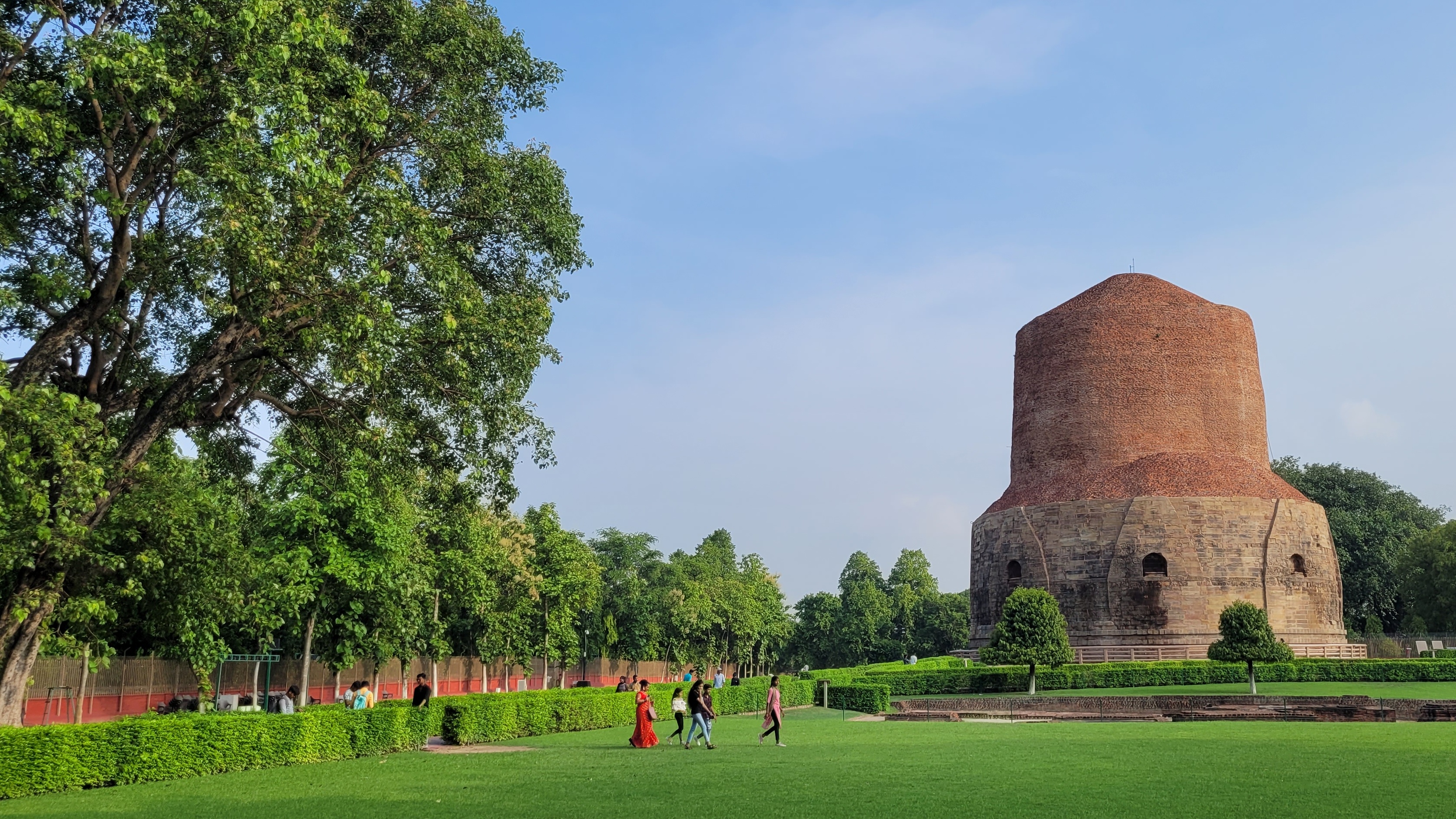
Dhamek Stupa is a Buddhist monument in Sarnath, approximately 10 kilometres northeast of Varanasi. Also written as Dhamekh Stupa, it stands within an archaeological landscape of monasteries, shrines and smaller stupas associated with one of the most important events in Buddhist tradition: the Buddha’s first sermon after enlightenment.
For visitors exploring Banaras, the stupa offers an introduction to the region’s Buddhist heritage. Its enormous cylindrical form is the main landmark, but the carved stonework and surrounding excavated remains deserve time of their own.
Why Dhamek Stupa is significant
According to Buddhist tradition, the Buddha travelled to Sarnath after attaining enlightenment at Bodh Gaya and taught his five former companions here. The first sermon is known as Dharmachakra Pravartana, or the turning of the wheel of Dharma, and is associated with the Four Noble Truths and the Noble Eightfold Path.
Dhamek Stupa commemorates this sacred setting. Its importance lies in its connection with the beginning of the Buddha’s teaching at Sarnath, alongside its value as a surviving historic monument.
History: understanding its different layers
Sarnath’s Buddhist remains span many centuries. Emperor Ashoka supported the site in the third century BCE, erecting monuments that included the Dharmarajika Stupa and a pillar. These are separate monuments from the standing Dhamek Stupa.
Official tourism accounts associate Dhamek with an earlier Ashokan foundation and date the later structure to around 500 CE. Its surviving stone decoration is linked to the Gupta period. It is therefore more useful to understand the monument as the result of successive building phases than to assign all its visible fabric to one ruler or date.
Architecture and details to notice
Dhamek Stupa rises approximately 43.6 metres and measures about 28 metres across. Its substantial brickwork and stone facing give it a distinctive cylindrical profile. The lower portion carries floral and geometric ornament, while exposed brickwork dominates the upper section.
Begin by viewing the monument from a distance to appreciate its scale, then look more closely at the surviving carved panels from the permitted paths. The contrast between the patterned stone and the brickwork makes a useful focus for both observation and photography.
Allow time for the wider archaeological area as well. Foundations and smaller structures help place the stupa within what was once a much larger religious complex.
What to do during your visit
Study the stone carvings: Look at the surviving patterns rather than treating the monument only as a backdrop for photographs.
Explore the excavated remains: Read the information boards and follow the designated routes between structures.
Visit Sarnath Archaeological Museum: Pairing the site with the museum adds context to the sculptures and architectural remains recovered here.
Leave time for quiet observation: Keep a respectful distance from anyone praying or reflecting.
As a planning suggestion, allow around 45–60 minutes for the stupa and archaeological grounds, or three to four hours for a broader Sarnath visit with the museum and nearby monuments. These are suggested durations, not official visiting limits.
Dhamek Stupa timings and entry fees
Incredible India and the Sarnath Museum visitor page list the excavated site’s hours as sunrise to sunset. The Kashi portal instead lists 9:00 AM–5:00 PM for Dhamek Stupa. Confirm the current gate hours locally, particularly if planning an early or late visit.
The ASI Sarnath Circle visitor page lists these archaeological-site ticket rates:
Visitor category | Cash | Card or online |
|---|---|---|
Indian, SAARC and BIMSTEC visitors | ₹25 | ₹20 |
Other foreign visitors | ₹300 | ₹250 |
These are the published rates checked on 23 October 2026. Confirm the applicable charge and available payment methods when booking or at the counter.
The museum has separate arrangements: its published hours are 9:00 AM–5:00 PM, it is closed on Fridays, and admission is ₹5, with free entry for children below 15. The museum’s Friday closure should not be treated as a closure notice for the archaeological grounds.
Location and how to reach
Dhamek Stupa is in Sarnath, Varanasi, Uttar Pradesh. The approximate 10-kilometre distance commonly given for Sarnath is an orientation figure; your actual journey will depend on where you start in Banaras.
A taxi or auto-rickshaw is a practical option for reaching the archaeological area. Ask for the entrance to the Sarnath excavated site or Dhamek Stupa, and check the return arrangement if hiring a vehicle for several stops. Allow extra travel time when returning for a train or the evening Ganga Aarti.
Planning a comfortable, respectful visit
For an outdoor visit, favour cooler conditions and avoid the strongest midday heat. Carry drinking water, sun protection and comfortable walking shoes. If mobility access is important, confirm the current entrance and path arrangements with site staff before travelling.
Stay on permitted paths, avoid climbing or touching fragile remains, and follow posted photography rules. Ask before taking close photographs of pilgrims, and keep voices low around prayer groups. ASI also asks visitors to keep the grounds clean and avoid smoking or defacing monuments.
Nearby places to combine with Dhamek Stupa
Sarnath Archaeological Museum is especially useful for seeing objects recovered from the site. Its collection includes the Lion Capital of Ashoka, whose four-lion design forms the basis of India’s State Emblem. The pillar remains and the capital are in different locations: the remains are at the archaeological site, while the capital is in the museum.
Dharmarajika Stupa remains and the Ashokan pillar remains belong in the same archaeological visit. Mulagandha Kuti Vihar and Chaukhandi Stupa can extend the outing into a wider exploration of Sarnath. Check each place’s access arrangements separately.
THE CONVERSATION CONTINUES
Conversations from the city
A question, a local tip, or a memory of your own. There’s room for your voice here.
Every perspective adds a little more.
Sign in to share yours, ask a question, or reply to the community.